
What to Look for in a Link Building Agency: A 2025 Guide for Australian Businesses

For Australian manufacturers, industrial firms, technology companies, and mid-market B2B operators, organic visibility is not just a marketing channel—it’s a competitive advantage. In markets where buyers research extensively before engaging, your ability to appear in trusted search results directly affects lead flow, credibility, and long-term commercial resilience.
Link building remains one of the strongest signals of authority in search. But with Google tightening enforcement around link manipulation and large-scale AI content abuse, businesses face a difficult task: choosing a partner who can build authority safely, sustainably, at volume, and with measurable impact.
This guide outlines what a modern Australian business should look for in a link-building agency in 2025, focusing on compliance, relevance, transparency, and ROI.
Why Link Building Still Matters in 2025
Backlinks continue to be one of the most reliable, durable contributors to strong organic rankings. They function as endorsements: indicators that external organisations trust your content enough to reference it.
Search engines still rely on backlinks as a key authority signal
While Google no longer provides a neat hierarchy of ranking factors, independent SEO research and correlation studies consistently place backlinks among the top indicators of authority, alongside content quality, topical relevance, and technical site health. Put simply: without external signals of trust, it is hard for a website to compete for high-value commercial terms.
Backlinks strengthen E-E-A-T
Google’s focus on Expertise, Experience, Authoritativeness, and Trustworthiness (E-E-A-T) means that high-quality, editorially earned links do more than boost rankings. They validate your organisation’s role in its niche. This is particularly relevant for Australian B2B sectors - engineering, IoT, industrial automation, sustainability, construction, and software - where buyers want evidence of credibility.
Links from respected Australian associations, trade publications, research organisations, or industry peers help confirm your position as a trusted source.
AI-driven search increases the importance of verifiable authority
Search engines and AI models now combine crawling, indexing, and large-model inference to determine what content to surface. These systems rely on strong external authority cues. High-quality backlinks remain one of the clearest, most verifiable signals available.
But link building is now a high-risk activity if done poorly
Google has hardened its stance on link schemes, scaled AI content abuse, expired domain manipulation, and low-quality paid placements. Penalties for misuse can be severe - rapid drops in visibility, loss of rankings, and long recovery times.
Mid-market firms can’t afford these disruptions, making partner selection a governance decision as much as a marketing one.
The Difference Between Good and Bad Link Building
Not all link building is equal. Understanding the spectrum helps you identify whether an agency is building genuine authority or exposing your website to risk.
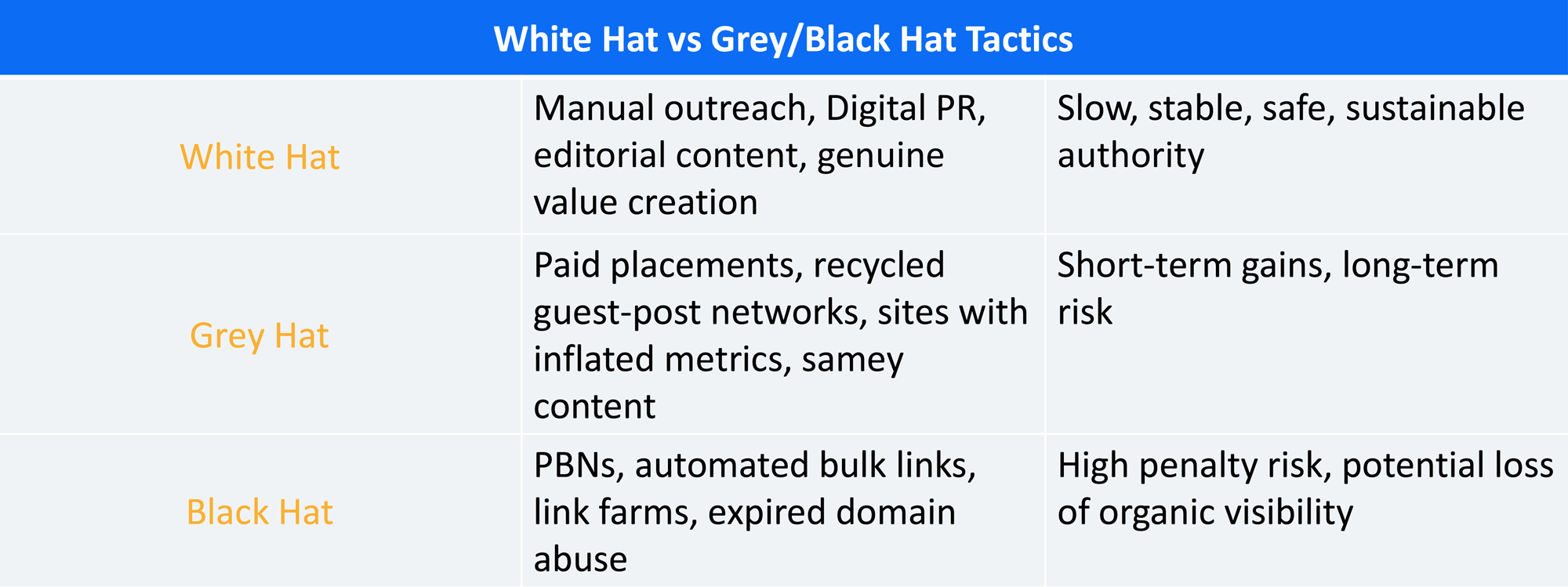
The safe option is always white-hat, editorially earned links built through relevant content and genuine outreach. However, some modern programs now include a controlled, human-reviewed layer of scalable supporting content - an ‘off-white’ approach - as long as quality, oversight, and compliance remain non-negotiable.
What high-quality link building actually looks like
A reputable agency in 2025 will use a combination of:
Content-led link earning (Digital PR): Creating genuinely valuable assets—research, insights, data reports, tools, or thought leadership—that other sites naturally want to reference.
Niche-relevant placement: A link from a respected Australian engineering publication is worth substantially more than a generic international blog with high Domain Authority but no topical relevance.
Manual outreach and relationship-building: High-quality link acquisition cannot be automated. Agencies should use targeted, well-researched outreach - not mass-blasted templates.
Genuine editorial review: Links should be placed inside high-quality, human-reviewed articles—not buried in footers, profile pages, or thin guest posts.
What low-quality link building looks like
Common red flags include:
Guaranteed DA/DR numbers (these metrics are easily manipulated)
“100 links per month” packages
Lack of transparency in where links will come from
Reliance on cheap offshore content
Over-optimised anchor text (e.g., repeated exact-match keywords)
Links placed only on irrelevant international sites
Re-used publisher lists shared with dozens of clients
These tactics are the primary targets of Google’s spam updates and carry substantial long-term risk.
Toxic vs Trusted Link Profiles: What an Agency Should Monitor
A trustworthy agency will not only build high-quality links but also actively manage risk.
Toxic link auditing
They should monitor and report on:
Spam signals
Foreign-language domains unrelated to your industry
Known PBN networks
Sites with no organic traffic
Sites experiencing sudden unnatural growth
Links placed in thin, low-value content
If necessary, they should advise when to use Google’s disavow tool - but sparingly and strategically.
Anchor text diversity
A natural backlink profile is dominated by:
Branded anchors
Naked URLs
Partial-match phrases
Navigational or generic anchors
If more than ~10% of links use the exact target keyword, it starts to resemble manipulation and can trigger algorithmic suppression.
Link relevance and placement quality
The best agencies prioritise:
Links within the main body of content
Contextually relevant paragraphs
Sites with real readership
Sites that rank for topics aligned with your market
Irrelevant placement can dilute E-E-A-T and waste investment.
How to Assess a Link Building Agency’s Strategy
Your evaluation should focus on methodology, transparency, and alignment with compliance standards.
Strategy-first approach
A credible agency will ensure:
Technical SEO is sound before link building begins
Your onsite content is strong enough to earn links
Keywords and link targets are commercially relevant
You understand where links will point and why
If an agency begins building links without checking the technical health of your site, the efficiency of your entire investment is compromised.
Transparency in sourcing
A trustworthy partner will:
Provide sample sites before starting
Explain their outreach methods
Avoid secret ‘exclusive lists’
Describe how they evaluate link quality
Provide clear criteria: traffic, relevance, editorial standards
Opacity is a warning sign.
Ethical use of AI
AI can legitimately support research, competitor analysis, and outreach personalisation. But a reputable agency will ensure:
All content used for link earning is human-reviewed
Editorial standards remain high
They follow Google’s guidelines on AI-assisted content
There is local expertise in context, language, and industry nuance
Agencies using AI to mass-produce low-value content are creating future risks.
Local relevance and accountability
For Australian B2B sectors, national relevance matters. A local agency understands:
Australian English
Australian industry associations
Local trade publications
Compliance expectations
Market realities
This directly improves the quality and impact of link placements.
However, AI-assisted content can be safely deployed when:
It is used to expand coverage of related topics
All outputs are reviewed and edited by humans
It contributes to a diverse, natural content ecosystem rather than scaled manipulation
The agency balances quality with controlled, ethical volume
Red Flags to Avoid in Link Building Services
Guaranteed metrics
Avoid agencies promising:
Guaranteed DA/DR
Guaranteed rankings
Guaranteed link volumes
These claims signal shortcuts and shortcuts invite penalties.
Secrecy around placement
An agency unwilling to share examples is almost always relying on recycled, low-quality networks.
Over-optimised anchors
If reports show repeated exact-match commercial keywords, your profile is at risk.
Low-quality or irrelevant content
Any partner relying on:
Spun content
Thin guest posts
AI-generated articles without human review
Content placed on irrelevant international blogs
…is exposing your domain to long-term damage.
No reporting on link quality
A good partner reports on:
Organic traffic of referring domains
Link placement location
Relevance and topical alignment
Anchor text ratios
Toxicity indicators
Rank movement on priority terms
Volume of links alone is not a meaningful metric.
What Good Link Building Reporting Looks Like
Modern reporting focuses on commercial impact - not vanity metrics.
Authority and risk metrics
A reliable report includes:
Organic traffic to referring domains
Referring domain relevance
Placement type (in-content vs sidebar/footer)
Spam indicators
Link velocity and profile health
Anchor text distribution
These metrics show whether the profile is trustworthy and sustainable.
Search performance metrics
Clear reporting on:
Changes in keyword rankings
Growth in organic visibility
Movement on high-value commercial terms
Competitor comparisons
This is where the value of link building becomes tangible.
Business impact
For mid-market teams, the commercial indicators matter most:
Organic lead volumes
Conversion rates
Contribution of organic search to revenue
Pipeline influenced by improved rankings
The best agencies help you interpret these numbers, not just provide raw data.
How Link Building Fits Into a Modern SEO Program
Link building is most effective when integrated with:
Technical SEO
Links cannot compensate for:
Slow page speed
Crawlability issues
Broken or unindexed pages
Poor site structure
High-quality onsite content
Your site needs:
Strong landing pages
Topical coverage
Clear keyword targeting
Useful, expert-led content
Digital PR and content marketing
Premium content assets enable the earning phase of link building.
A good agency will help identify:
Research opportunities
Data stories
Industry insights
Product innovations
Local relevance hooks
Ethical AI support
AI should enhance, not replace, expert oversight.
The strongest results come from agencies that combine:
Manual outreach
Real editorial standards
Topical relevance
Quality onsite content
Technical SEO readiness
Clear reporting and risk management
Ethically scaled, human-reviewed supporting content
Link building is not a standalone service; it is an authority-building program that only works when the entire digital ecosystem is aligned. Modern SEO increasingly benefits from a distributed set of related articles across the web - often AI-assisted but human-reviewed - that collectively reinforce topical authority. This combination of premium onsite content, supporting offsite articles, editorial links, social signals, and industry friendships more closely reflects how real authority develops online.
Questions to Ask Any Link Building Agency
You can quickly identify a high-quality partner by asking:
Where will my links come from? Ask for recent examples and criteria for relevance.
Do you use PBNs or bulk link buying? The answer should be an immediate no.
How do you evaluate link quality? Look for references to organic traffic, relevance, and editorial fit - not just DA/DR.
Who writes the content used for link earning? Ensure it is industry-appropriate and that humans are part of the process.
How do you measure success? Strong partners focus on rank movement, organic performance, and commercial impact.
How do you manage anchor text and link risk? This reveals whether they understand compliance and profile health.
How do you use AI in your workflow? Look for a balanced answer: AI for scale and efficiency; human oversight for quality, context, and compliance.
Choosing a Link Building Partner in 2025
Selecting a link building agency is no longer just a tactical decision - it affects compliance, reputation, and long-term organic performance.
A trustworthy partner in 2025 will:
Prioritise quality over speed
Use ethical, white-hat, editorially earned tactics
Focus on relevance and topical authority
Provide transparent reporting
Integrate with technical and content SEO
Understand the Australian B2B landscape
Communicate clearly about risk and ROI
Support authority-building with a broader, ethically scaled content ecosystem
In a landscape shaped by rapid algorithm changes and increasing scrutiny of link manipulation, sustainable authority building requires a holistic approach.
