
Australia's Fuel Import Dependency Is a Structural Vulnerability
We walked past the University of Newcastle this morning. A sign announced their 100% green energy supply. Passengers boarded a renewable-powered bus. Against the backdrop of record fuel prices, a few electrified examples caught our attention—but make no mistake, the Hunter Valley is Australia's industrial heartland. We mine coal and burn hydrocarbons at least as much as any other region.
Our colleagues in manufacturing, heavy industry, and logistics are travelling less. Some are meeting fewer clients face-to-face. Others are waiting for fuel availability issues to force production shutdowns. Many businesses are determined to keep their promises, and are losing money on every product they ship because transport costs have exploded.
At Arrow, our workplace runs on solar. Our vehicle charges on site. Fuel costs for us have dropped to almost zero, whilst prices have risen 139% for everyone else.
The Strait of Hormuz disruption pushed crude above US$100 per barrel for the first time in four years. Australia imports approximately 90% of its fuel. We hold 39 days of petrol reserves and 30 days of diesel. Those aren't buffers. They're countdown timers, and everyone's getting pretty edgey about it right now.
The Maths Have Changed
When we pushed through our own electrification decisions, they didn't stack up on paper. Solar and electric-vehicle transitions looked like 7- to 8-year break-evens. Feed-in tariffs were eroding. We probably would have been more profitable investing in people and processes instead.
We made the decision because it felt right. Someone needs to go first. Being the last mover on climate didn't align with our values for our business, community, or children.
The dividends are real now though.
Energy prices are climbing. And we're close to self-sufficient on electricity, including vehicle charging on site. Our colleagues, though, are absorbing a big financial shock. While we count ourselves lucky.
Managers are paid to focus on operational performance. Unless your organisation is small enough that someone with a strong opinion can push the environmental agenda, innovation portfolio planning uses the standard lens. Will it contribute to growth? Will it deliver operational efficiencies? If the answer isn't yes, it's hard to prioritise these choices and keep your job.
None of us had a crystal ball on energy prices—gas, electricity, liquid fuels, all of our energy sources. The maths have changed though. Maybe these uncomfortable energy costs are helping us see the processes that are unsustainable, rather than scientists just telling us that they're unsustainable?
Reassuringly Expensive
If we want to accelerate electrification, perhaps high energy prices should stay. Not at crisis levels. Perhaps we should reduce them after this global supply issue resolves, but never to their previous lows. Perhaps we should know that hydrocarbons and energy produced from them will increase to a certain predetermined number every few years?
Something that won't break every business, but still reassuringly expensive.
High enough that every operation has the forward visibility to redo the maths and make decisions that contribute to their success and to Australia's evolution toward a carbon-neutral future. The revenues from additional fuel taxes could accelerate green energy collection and storage initiatives, fleet electrification, along with building efficiencies and climate resilience.
The Strait of Hormuz situation delivered the price increase with no warning. It created a fuel availability risk, which means even if you want to continue delivering services as normal, you may not be able to fill your machines to do so. As a country and industry participants, we're not planful right now. We're surprised, in financial stress, and reacting as best we're able.
Staged increases that everyone knows are coming would give organisations time to plan. Potentially several years apart. Ending up at a fuel price that factors in the true, unsubsidised cost of extracting natural resources, getting them to market, and fully mitigating the impact of mining them in the first place and removing the resultant pollution and CO2 from the environment.
Through that lens, our current prices above $3 per litre seem cheap. So cheap they're distracting consumers and industry away from electrification.
With a bit of warning, smart people in good companies can evolve with purpose. Industries shift, mature, and sometimes retire because they're no longer fit for purpose. Organisations look at their expertise and move into new and adjacent offerings. That only works with forward visibility, not crisis-driven surprises.
The Infrastructure Problem
Governments don't lead. They follow public opinion. Our elected representatives play a balancing act because they want to get elected. Leading into an election with a policy like "we're going to increase fuel costs so much it’ll make your eyes water" would be a hard sell.
But our colleagues in industry are experiencing eye-watering fuel costs anyway—just without the planning runway or the tax revenue going towards rapid transition infrastructure deployment.
The first step would be to reinstate and even increase fuel taxes immediately after the Strait of Hormuz situation resolves. Specifically saying “we're investing in the infrastructure so that if you invest in these technologies—green energy, green fleets—it won't happen to you again”.
The economic case for electrification strengthens considerably when the grid itself runs on abundant renewable power. South Australia's progress in getting very high levels of electricity from variable green sources positions it to extract maximum value from electric vehicles and process equipment—you're charging with clean, cheap power rather than coal-fired electricity. That grid composition amplifies the operational advantage of electrification and makes the investment case more compelling for industries seeking cost certainty.
We read about a recently concluded 2.5-year forestry trial in which an electric semi-trailer could do the job of a diesel one, but the charging infrastructure was likened to "buying the petrol station" rather than just the fuel. Removing subsidies for fossil fuel industries, increasing fuel taxes in a controlled manner, and deploying the infrastructure at scale would help de-risk industry in the coming months and years.
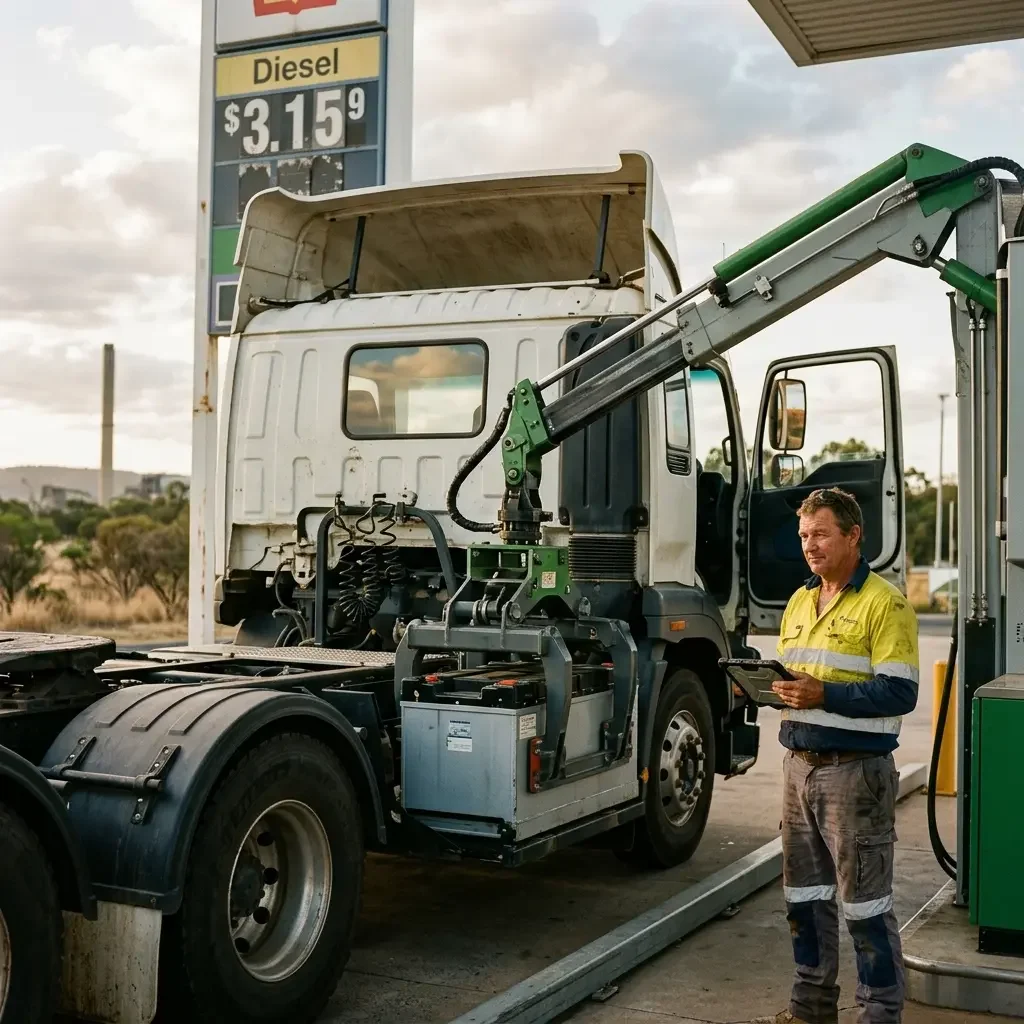
Local councils, state and federal governments struggle with what to choose. EV charging stations? Solar subsidies? Big local batteries? Substantive green energy projects? Or help companies like Janus Electric develop their hot-swap-battery framework for heavy transport?
When heavy transport batteries end up being a standard size and shape, every petrol station in the country could let you pull up, swap them out, and continue for the next 500km.
It's a coordination problem. Governments can't decide between competing solutions, so nothing gets the concentrated support needed to reach scale.
The $17 Billion Question
It would take money. It would need to be on the same order of magnitude as the fuel tax our country collects or the subsidies we provide to our fossil fuel industries. Both of those numbers are around $17 billion per annum.
For $17 billion, you could convert well over 20,000 trucks to electric. That includes deploying infrastructure to keep them on the road, such as spare batteries, charging stations, and the like, on key routes. It would take five or six years to get the job done with that level of annual investment. You could transition every semi-trailer and petrol station in the country for that.
Our colleagues in logistics and heavy industry are bleeding money or winding back production right now. They say they're already running too lean. They can't come up with the $750,000 per vehicle to upgrade their trucks and charging infrastructure without support.
Australia's 16.7% EV market share of new cars sold represents a measurable exposure reduction. Over 454,000 passenger vehicles are no longer vulnerable to imported fuel price spikes. But that's still only 2% of all cars on our roads.
Organisations that have already electrified key workflows haven't had to wind back production or travel. They're watching everyone else absorb the fuel price shock whilst counting themselves fortunate indeed.
What This Means
Electrification removes the link between Middle Eastern instability and Australian energy costs. It shrinks or eliminates the hydrocarbon bill for households, fleets, and industry. That's not environmental compliance—it's exposure management.
The organisations bleeding money right now made rational decisions based on the information they had. Diesel was proven. Electric was risky. The business case didn't make sense to them at the time. But the Strait of Hormuz disruption proved that 'proven’ technologies carry hidden exposure that doesn't appear in portfolio planning models until geopolitical events make it suddenly, expensively visible.
We made our electrification decisions because they felt right, not because the maths worked. The operational defence value is clear now—but only because energy prices moved. The real lesson isn't that early movers got lucky. It's that without forward visibility on energy costs, rational managers will continue choosing proven technologies with understood ROI over newer alternatives that carry execution uncertainty.
Australia has the capability. Janus Electric and others demonstrate the technical solutions exist. South Australia proves renewable grids amplify the economic case. The $17 billion we spend on fuel taxes or fossil fuel subsidies could fund the transition. Take your pick. What's missing isn't technology or capital—it's coordinated deployment and price signals that give organisations the planning runway to make these investments before the next supply shock hits.
The question isn't whether Australia should accelerate electrification. It's whether we'll do it planfully, with staged fuel price increases and infrastructure investments, or continue learning through expensive, crisis-driven surprises.
Written by Jeff Anderson, Founder of Arrow Strategic Communications.
Jeff leads strategy, software delivery, and workflow transformation initiatives across Australia.
