

A digital transformation should leave people with less chasing and repeated work, more time for customers and better information to act on. Managing multiple suppliers means making their contributions add up to that change.
Consider a familiar situation. A new system is running, an integration is complete, and a supplier has delivered its training. But staff still copy information between screens, chase colleagues for updates and maintain a spreadsheet on the side to see what needs attention. Each supplier may have fulfilled its brief. But the business is still waiting for its way of working to change.
When software, workflows, communications and internal teams depend on one another, someone needs to coordinate the whole result. That is the practical purpose of digital transformation governance: deciding who owns the outcome, who can make decisions and what evidence will show the project is succeeding.
Define what should change in an ordinary working day
Start with the work people should be able to do differently. Perhaps an enquiry should reach the right person without being re-entered. A team should know which jobs need intervention. A manager should be able to investigate performance without asking three different people to assemble a report.
Describe the intended change in observable terms. Who will use it? What will become easier or more reliable? What valuable work will people have more capacity to do?
That description gives suppliers a common reference when their individual scopes meet. A faster data transfer has limited value if the receiving team still cannot tell what action to take.
Agree the starting position too: current handling time, repeated work, delays or unresolved exceptions. Choose measures the business can reasonably maintain. Where priorities or success measures are still unclear, resolve those through business planning before asking suppliers to optimise separate parts of the workflow.
Put the right expertise behind the outcome
People should work to their strengths. Running a business, understanding customers and managing a complex implementation are different skills. An experienced operational leader may know exactly what has to improve while still benefiting from specialist support to coordinate delivery.
Give three responsibilities explicit owners:
Business ownership: a sponsor who owns priorities, funding decisions, acceptable risk and the intended outcome.
Delivery coordination: a lead who brings the suppliers and internal teams together, manages dependencies and gets decisions resolved.
Specialist delivery: the people responsible for designing, building, explaining, testing or operating each contribution.
These responsibilities need appropriate expertise, time and authority. They do not necessarily require three new hires. On a smaller project, people can combine roles where the workload, their skills, and conflicts of interest allow it.
Choose the delivery lead for their ability to connect the work across organisational boundaries. That person may be internal or external. A supplier can lead delivery too, as long as the business retains informed control of its priorities and acceptance decisions.
Good digital transformation project management should leave the organisation able to understand its choices, operate what has been delivered and direct what happens next.
Manage the work between suppliers
Follow an important workflow from its trigger through to its useful result. At each hand-off, identify what one party supplies and what the next party must be able to do with it.
For example, a form supplier may capture an enquiry correctly while the receiving system assigns it to a queue nobody monitors. The useful acceptance test follows the enquiry through to a responsible person acting on it.
Make a copy, then add your own workflow, responsibilities and evidence.
Ask the contributing parties to agree the information, timing, permissions and exception behaviour at that boundary. Name a coordinator for resolving mismatches. Check who needs to participate when either side changes something.
This reflects an established systems principle: NASA's interface-management guidance calls for defining interfaces, coordinating changes, and verifying compatibility. The business application can be a bit more agile, obviously. It’s not rocket science.
Arrow's accompanying one-page delivery hand-off map makes that practical. Use it for a few important boundaries, linking to existing requirements and test evidence. Surface gaps in the agreed scope early so the client can decide who will do the work and on what terms.
Suppliers may also compete for future work. Agree the cooperation needed for the current outcome, including access to relevant information, joint testing and issue resolution, while respecting legitimate confidentiality.
Make decisions and commercial interests explicit
Shared discussion works best when everyone knows who will decide. Set out what the delivery lead can approve, which decisions belong to the business and what must be escalated. Include a decision deadline and the consequence of waiting.
For a change crossing multiple supplier scopes, establish its operational impact, cost, dependencies and options before approval. If it exceeds an agreed budget, risk or scope limit, take it to the authorised decision-maker while there is still time to act.
The Australian Government Digital Transformation Agency's research with the University of Queensland supports clear authority and separation of supplier interests from decisions about their own scope or payment. An established business can apply that principle through a small number of named people and clear delegations.
Suppliers should explain their recommendations and the implications of alternatives. The authorised client representative makes the commercial decision. Where Arrow coordinates a project and also delivers part of it, the same rule applies: client acceptance and appropriate separate review must remain explicit.
Keep one shared view of what is ready, what is blocked, which evidence is missing and who needs to decide. Use meetings to resolve those matters. Reuse the delivery records so contributors can spend their time on the work rather than preparing overlapping status reports.
Test the working outcome through release
A change can be technically correct and still leave people unable to complete their work. Agree what successful use will look like across the participating suppliers and users before the process goes live. Use those acceptance scenarios to decide when the job is done.
Test the ordinary journey and the exceptions that matter. What happens if information arrives twice, a record changes after an action is scheduled, or a person lacks the required access? Can the team see the problem and recover safely?
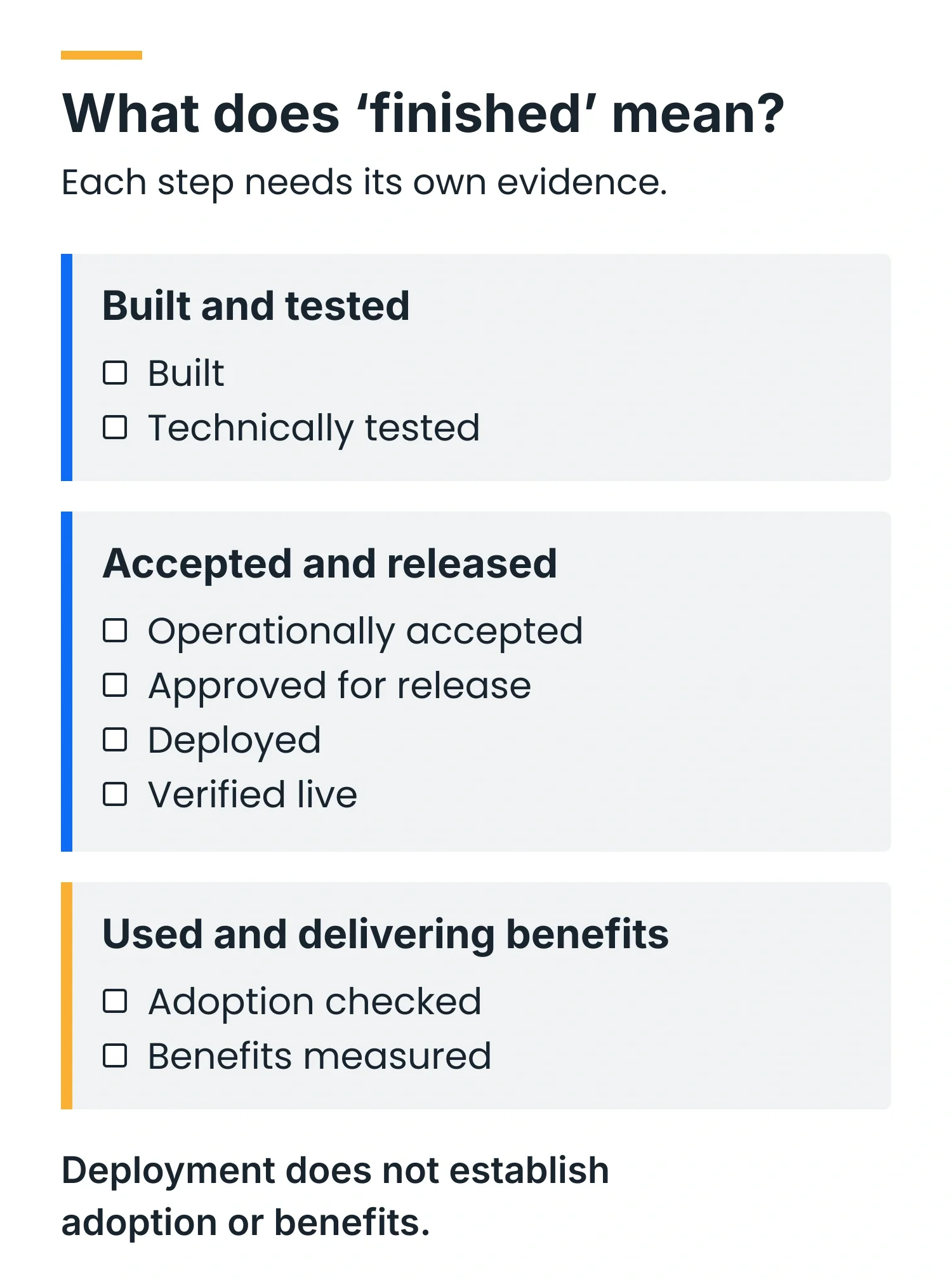
Keep the following distinctions visible in release decisions:
Built: the supplier has delivered the specified change.
Technically tested: checks provide evidence that it behaves as intended at a technical level.
Operationally accepted: authorised business users or reviewers have checked the agreed workflow against acceptance criteria.
Approved for release: the accountable decision-maker has considered the evidence, unresolved issues and readiness to proceed.
Deployed: the approved change has reached the live environment.
Verified live: its important behaviour has been checked there, including relevant dependencies.
Adoption and benefits need their own follow-up after those delivery checks. Where the change includes customer communications, training or operating procedures, check those alongside the software. People need consistent instructions, usable information and support when the new workflow goes live.
Staging gives teams somewhere to test away from live operations. A pre-live environment or release stage can check the exact version and configuration intended for deployment. The appropriate arrangement depends on risk and complexity; each project's environment names and purposes should be explicit.
Across suppliers, agree what must move together, who checks dependencies and who can authorise the release. Retain evidence against the version tested. A later change may require earlier checks to be repeated.
Prepare support, recovery arrangements and live verification before release. Record unresolved limitations clearly so deployment cannot become a claim that the whole workflow has been accepted.
Make the business's data usable by the business
When different suppliers capture, process and report information, they can attach different meanings to apparently identical fields. A dashboard may look convincing while counting a different event from the one the business thinks it measures.
Agree what each important record represents, how records relate and which source is authoritative. Define dates, statuses and missing values. Check how corrections flow between systems.
Then test a real business question. Can an authorised user identify where work is waiting, investigate why demand changed or compare service performance using records that reconcile to the source?
Give people the explanations, access and export or reporting capabilities needed to explore those questions. A supplier may still provide specialist analysis, but routine understanding should not depend on commissioning a fresh explanation every time.
Practical control of data also needs agreed access and handover arrangements. A useful export does not settle contractual ownership or future portability.
This is part of technology and business transformation: connecting software and information with people's ability to act. Better visibility creates opportunities to improve performance. Whether conversion, quality or customer experience actually improves still needs to be measured.
Check adoption, capacity and benefits after deployment
Before release, agree who will own the new workflow after the suppliers finish their work. That business owner needs a way to report friction and get support across supplier boundaries, so users don't have to diagnose which provider caused a problem.
Look at actual use. Are eligible tasks going through the new workflow? Where are people falling back to spreadsheets or manual messages? Ask why. A workaround may reveal missing functionality, unclear responsibility, insufficient training or an exception nobody anticipated.
Compare the resulting work with the starting position, allowing for differences in volume and complexity. Track handling time alongside repeated work and quality. A faster step that creates extra downstream work may have simply shifted the burden.
When time is released, identify what it enables: more attention to customers, earlier intervention, additional work without the same administrative load, or time for improvement that previously went undone. Capacity has value even when payroll expenditure stays the same. Cash savings require separate evidence of avoided or reduced spending.
The DTA's benefits guidance recommends revisiting expected and actual benefits and recognises that some emerge after delivery or are influenced by other changes. Set review dates around when people can realistically use the new capability, with someone responsible for acting on what the review finds.
Find the delivery responsibility needing attention
Take one important workflow and use the hand-off map to follow it across the suppliers and internal teams involved. Check whether someone owns the combined result, each receiving party can demonstrate successful use, and decisions have an authorised owner.
Look beyond the release. Who will help people adopt the workflow? Who can investigate the data? Who will check that the business has gained the capacity or service improvement it intended?
The gaps will help you decide what support is needed. You may need to give an internal lead more time or authority, engage a particular specialist, or bring in someone to coordinate delivery across the whole project.
Arrow's DELIVER service provides project leadership and coordination across internal teams and suppliers. It connects delivery decisions with the operational change the organisation is trying to achieve.
A useful starting point for that conversation is the working day you want people to have, and the hand-offs currently preventing it.
Written by Jeff Anderson, Founder of Arrow Strategic Communications.
I spend my time helping organisations of all types identify and resolve what frustrates their people, wastes time, costs money, or gets between them and their customers. That often means bringing internal teams and specialist suppliers together, working through the difficult hand-offs and checking that the changes make everyday work better.
Learn more about Arrow’s project leadership and delivery coordination.
