
Australia does not have a shortage of sustainability frameworks, carbon calculators or reporting requirements.
It has a translation problem.
The information needed to measure environmental performance already exists inside most organisations. It sits across invoices, spreadsheets, finance systems, fleet records, electricity accounts, supplier documents, production systems and operational databases.
The difficulty is collecting it, checking it, classifying it and reshaping it into the formats required by regulators, customers, certifiers and international supply chains.
That problem led Arrow to establish SDM-X — Sustainability Data Management Australia.
The initiative began in July 2024 through discussions with sustainability, artificial intelligence, and software development specialists in Australia, the United Kingdom, and Spain. Its objective was ambitious but practical: make sustainability data management more accessible, repeatable and commercially useful for Australian organisations.
Over the following year, Arrow coordinated an end-to-end program spanning business planning, customer discovery, sustainability research, software development, workflow optimisation, commercialisation and industry collaboration.
The core SDM-X initiative concluded in September 2025 after achieving its principal research, development and validation objectives. Selected intellectual property was handed to the sustainability partners who owned it. Arrow continues to leverage and deploy the commercialisation, data-readiness, data-reforging, workflow and software-development capabilities demonstrated and further developed through the project.
SDM-X became proof of what can happen when scientific expertise, commercial planning, data management and software development are treated as one connected system.
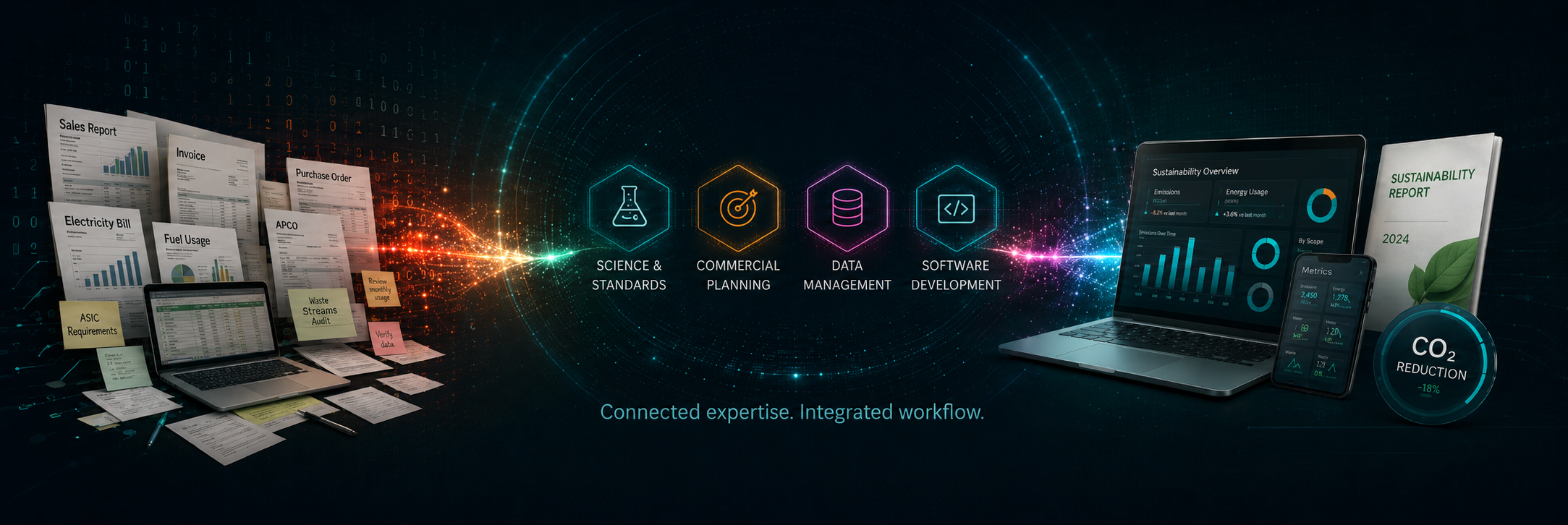
The sustainability reporting problem is operational
Many sustainability initiatives begin with the assumption that an organisation needs a calculator.
The deeper problem usually relates to the challenges of data readiness before any calculation begins.
A business may need to identify fuel purchases, electricity consumption and production, refrigerants, freight, waste streams, business travel, purchased products, supplier emissions and other activities. That information may be recorded inconsistently across multiple systems, business units and reporting periods.
Even when the source data is available, it likely won’t be ready to use.
One supplier invoice may contain information relevant to:
The organisation’s finance system
Scope 1, Scope 2 or Scope 3 emissions
Product circularity requirements
Packaging reporting
Customer procurement questionnaires
Product carbon footprints
Future regulatory or certification processes
Without a structured data-readiness process, the same information must be collected, interpreted, and reformatted repeatedly.
SDM-X was designed around the idea that organisations should be able to prepare important sustainability data once and then reuse it across multiple legitimate reporting and commercial requirements.
Its early positioning described a modular compliance and data toolkit that could help businesses plan their sustainability strategy, measure environmental impact, reduce emissions, pursue certification, enrich existing information, and share approved data more securely with other supply-chain participants.
More than a carbon calculator
Arrow did not approach SDM-X as a single software-development project.
It was treated as a comprehensive capability development and commercialisation initiative.
Arrow’s role included:
Business and commercialisation planning
Value proposition and business-model development
Customer discovery and stakeholder interviews
Audience segmentation and hypothesis testing
Grant identification, preparation and applications
Product management and project delivery
Sustainability methodology development
Standards research and comparative analysis
Software design, prototyping and testing
Lifecycle assessment reporting enhancements
Data-readiness and reporting workflow design
Time-and-motion studies
Business metrics and performance tracking
Branding, customer-facing language and website development
Coordination between scientists, technology specialists, researchers, industry organisations and prospective users
The work required Arrow to move continuously between scientific detail and operational reality. Technical standards had to be interpreted accurately. Software interfaces had to be usable by people who were not sustainability specialists. Commercial models had to reflect how Australian organisations actually purchase consulting, technology and certification services. Complex material had to be translated into language that decision-makers could understand without diluting its meaning.
This is the connective work that often determines whether a new capability reaches practical use or remains a collection of reports, prototypes and good intentions.
Building working carbon-accounting technology
SDM-X produced working and prototype tools across organisational and product-level carbon accounting.
The technology work included:
Prototype organisational carbon-footprint calculators
Prototype product carbon-footprint calculators
Beta and functional organisational carbon-emissions software
Prototype ASIC sustainability-reporting processes
Prototype Open 3P datasets for product circularity
Prototype Catena-X data manipulation
Software-supported data preparation and calculation workflows
The organisational carbon emissions software was developed using progressive web application technology, with substantial integrations with Microsoft Excel and SQL.
That combination mattered.
Excel remains deeply embedded in Australian business operations, while SQL provides the structured data handling required for repeatable calculations, reporting and future integration. The progressive web application created a more accessible interface over those underlying processes.
The objective was not to remove professional judgement from carbon accounting. It was to remove the avoidable transcription, duplicated handling, inconsistent classification and repetitive calculation work surrounding it.
The SDM-X website reflected this broader approach. Its measurement pathway connected organisational carbon footprints, product carbon footprints, lifecycle assessments, greenhouse gas reporting, and enterprise data management rather than presenting them as isolated products.
From data readiness to data reforging
One of the most important concepts developed through the initiative was data reforging.
Data reforging means taking information that already exists within an organisation and reshaping it so it can perform more than one useful function.
Consider the invoices entering a business.
A conventional accounts process may extract the supplier, date, amount, tax and work out the expense category.
A sustainability workflow may need to identify the underlying activity, quantity, material, energy source, and transport component for the likely emissions classification.
A circularity framework may require an additional set of product, material or packaging attributes.
Rather than asking separate teams to process the same and adjacent data sets repeatedly, a data-reforging workflow can:
Capture the source information
Retain the original record
Extract relevant fields
Classify the information for finance and operational systems
Identify likely Scope 1, Scope 2 and Scope 3 relevance
Map applicable information to other standards
Prepare approved outputs for specific recipients
Preserve control over the organisation’s underlying data
This creates a reusable managed data asset rather than another one-off reporting exercise.
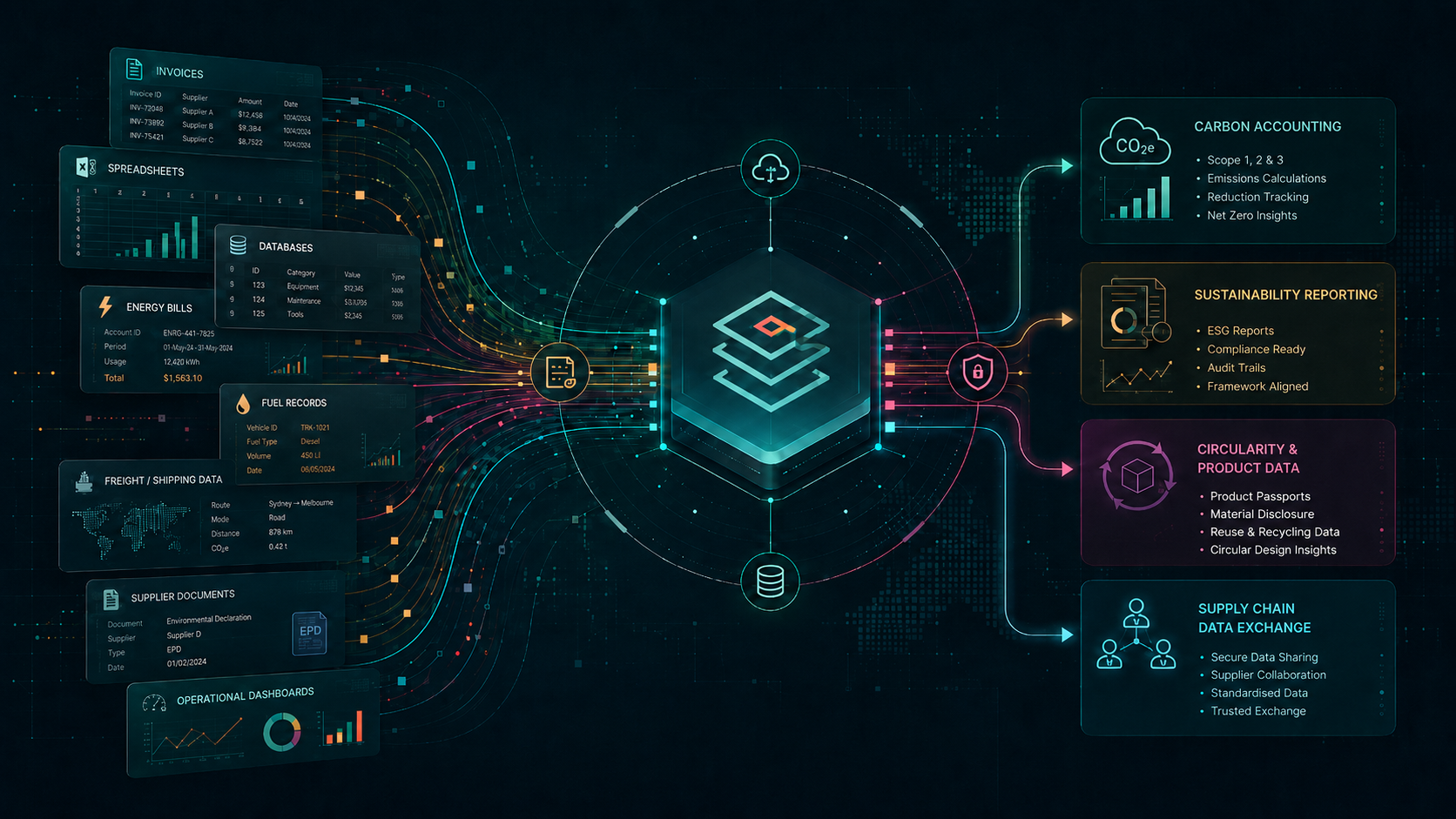
The approach was particularly relevant to medium-sized organisations that could not justify the cost of expensive enterprise sustainability platforms that were never built to Australian requirements, or repeated manual consulting engagements.
Related research undertaken in collaboration with the University of Newcastle envisaged the ‘Dataforge’ capability as follows: collecting business records, translating them into different reporting structures, and selectively distributing only the information required for a particular calculation, customer, or framework.
The research identified data readiness - not the absence of calculators - as one of the largest remaining barriers for smaller organisations. It recommended a system that could integrate with accounting platforms, maintain data sovereignty, protect commercially sensitive information and support emerging data-exchange frameworks.
The data reforging concept, validated during the SDM-X project, remains relevant well beyond carbon accounting. Data reforging can support financial reporting, procurement, product traceability, circularity, governance, operational improvement, and supply-chain disclosure without forcing organisations to rebuild their information from scratch each time.
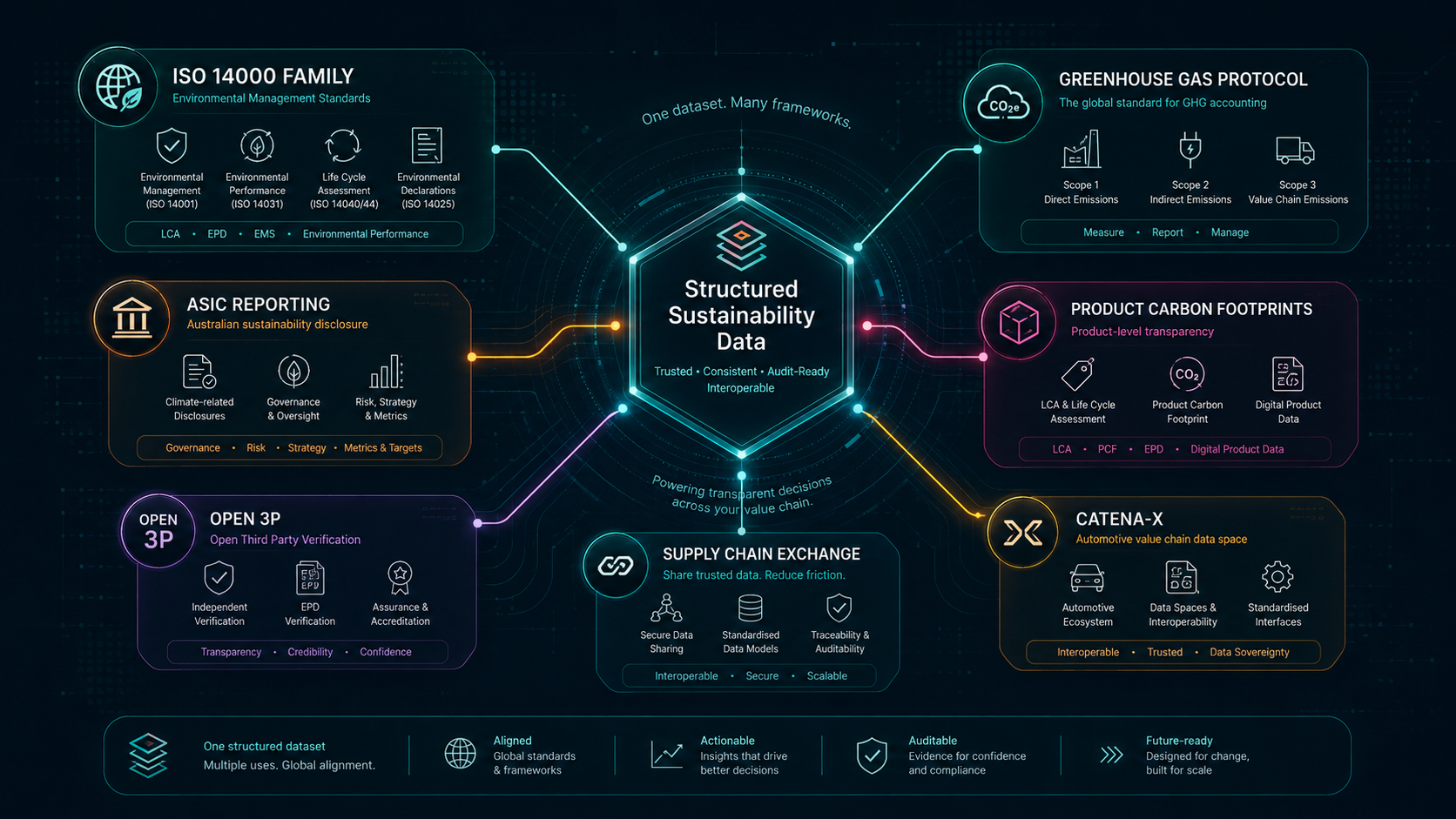
Aligning the ISO 14000 family with the Greenhouse Gas Protocol
Sustainability reporting is not governed by one universal methodology.
Different standards address different boundaries, products, organisations, claims, data exchanges and assurance requirements.
The SDM-X initiative reviewed how these systems aligned, where gaps remained, and what Australian organisations needed to prepare their data for emerging requirements.
The research included:
AS/NZS ISO 14040, 14041, 14042, 14043 and 14044 for lifecycle assessment
ISO 14025 for environmental product declarations
ISO 14064 for organisational greenhouse-gas quantification, reporting, projects and verification
ISO 14065 and ISO 14066 for validation, verification and competence
ISO 14067 for product carbon footprints
ISO 14068 for net-zero transition and carbon neutrality
The Greenhouse Gas Protocol corporate and Scope 3 approaches
Open 3P packaging and circularity data
Catena-X and Manufacturing-X data-exchange models
Product carbon-footprint exchange through PACT and WBCSD
European ecodesign and digital product passport requirements
APCO and GS1 packaging and traceability initiatives
Climate Active and other certification pathways
Lifecycle inventory datasets, including AusLCI and Ecoinvent
Australian and international carbon credit, registry, and verification systems
The intention was not to claim universal implementation of every framework.
It was to understand the full landscape well enough to design workflows and technology that could remain useful as customer, regulatory and industry requirements evolved.
The SDM-X standards register demonstrates the breadth of the research undertaken across organisational and product carbon accounting, packaging, international data exchange, Australian governance, datasets, certification and offsets.
This standards work also reinforced a recurring conclusion: sustainability data should not be locked permanently into one consultant’s spreadsheet, one proprietary calculator or one reporting framework. Organisations need data structures that can adapt.
Turning 40 hours into 30 minutes
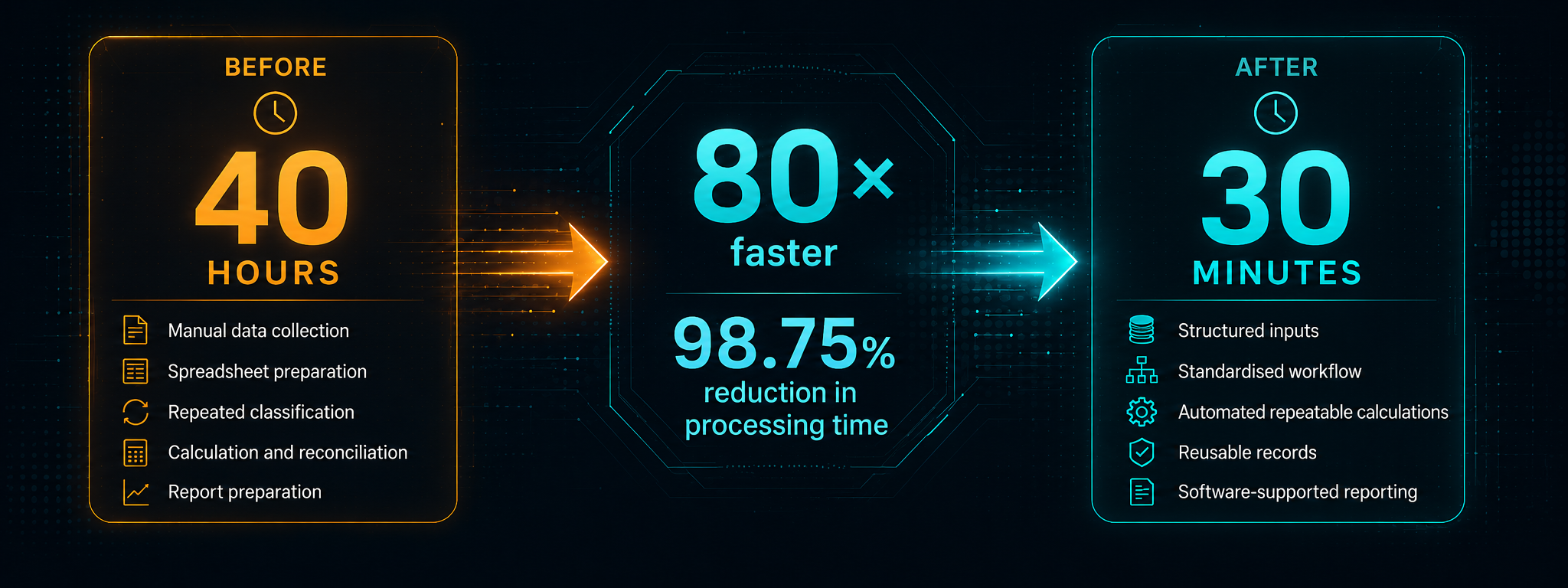
The strongest proof point from the project came from the organisational carbon footprint calculation. Across real-world lifecycle assessment engagements with Australian manufacturing and service organisations, Arrow helped refine the process to the point where approximately 40 hours of consultancy effort was reduced to around 30 minutes.
That represents an 80-fold acceleration and a reduction of approximately 98.75% in processing time.
The result did not come from ignoring standards or reducing the quality of the calculation.
It came from redesigning the surrounding process:
Improving data readiness
Standardising inputs
Automating repeatable calculations
Reducing manual transcription
Reusing structured records
Removing duplicated handling
Integrating spreadsheets, databases and software
Clarifying reporting boundaries
Designing workflows around the actual task rather than inherited practices
The participating organisations spanned industrial equipment manufacturing, IoT, recycling and waste management, commercial cleaning, service operations and wine-industry participants.
Moving from reporting to action
Measurement was never intended to be the final outcome.
The SDM-X work also considered how emissions information could support practical operational decisions.
Areas of particular relevance to collaborators included:
Emissions-reduction recommendations
Renewable energy and energy storage
Fuel management
Fleet management
IoT technologies for remote worksites
Waste and recycling
Operational efficiency
Supply-chain risk
Carbon-neutrality pathways
Selection of sustainability consultants, technology vendors and certifiers
A useful carbon footprint should help an organisation identify where emissions occur, which activities are material, what information is uncertain and which interventions are commercially realistic.
That may lead to a technology investment, an operational change, a supplier discussion, a fleet decision, a data-quality improvement or a more appropriate certification pathway.
The SDM-X model therefore linked planning, measurement, reduction, certification, data reuse and secure information exchange.
Collaboration across science, industry and commercialisation
SDM-X was developed through a broad collaboration network.
Arrow engaged with Australian and international sustainability, data and software specialists, as well as organisations including APCO, ASIC, WBCSD, Catena-X and GS1.
The initiative also involved the University of Newcastle’s commercialisation teams and School of Science, the I2N Pre-Accelerator program and the wider Hunter innovation community.
Multiple research initiatives were undertaken with the University of Newcastle School of Science, contributing to student learning outcomes and the development of life-ready graduates.
These projects allowed students to work on real Australian business challenges involving carbon reporting, life cycle assessment, data readiness, product carbon footprints, standards alignment, circularity, and sustainability technology.
The relationship was not simply about obtaining research.
It created a structured exchange between academic inquiry, commercial constraints, technology development and organisational pain points.
Students examined the systems surrounding Scope 3 emissions, data sovereignty, the role of Open 3P and Catena-X, and the challenge of preparing smaller organisations for participation in more sophisticated sustainability-data ecosystems and certification pathways.
Completing the initiative and handing over the IP
The principal SDM-X initiative concluded after achieving its core research and development objectives.
The organisational carbon footprint calculator, its brand, customer-facing workflow and language, and associated lifecycle assessment templates were handed over to the Queensland sustainability partners who own that intellectual property.
The commercial opportunity had been validated, but the work also showed that another standalone sustainability platform was not necessarily the strongest model for the market.
Australian organisations did not simply need another login, another subscription or another calculator.
Many required a more flexible combination of:
Data preparation
Workflow redesign
Carbon-accounting support
Governance
Technology integration
Software automation
Standards interpretation
Access to the right sustainability, verification and certification specialists
That model aligns closely with how Arrow works: diagnosing the actual constraint, bringing together the right expertise, improving the workflow, and delivering the required technology or operational capability.
SDM-X demonstrated Arrow’s ability to coordinate complex work across strategy, science, technology, data, communications and commercialisation.
Arrow continues to apply those capabilities through project-based engagements.
Current areas of support include:
Sustainability workflow assessment and optimisation;
ASIC sustainability governance and reporting process preparation
Data readiness: Microsoft Excel and SQL integration
Data reforging and workflow automation
Custom sustainability software development
Data analysis and system design
Alignment with emerging Australian and global data standards
Customer discovery and commercialisation planning
Translation of scientific and technical requirements into operating processes
Sustainability consultant, vendor and certifier selection, particularly in the context of carbon accounting and life cycle assessment workflows
The lesson from SDM-X is visible in the work itself.
Creating a new capability requires more than an idea or a strategy document. It requires that the problem be researched, the assumptions be tested, the workflow be understood, the technology be built, the language be clarified, and the result be proven in practice.
That is what Arrow does.
If your organisation is reviewing its sustainability, data management, or governance workflows, Arrow can help optimise the process and eliminate bottlenecks that are holding you back.
Written by Jeff Anderson, Founder of Arrow Strategic Communications.
Jeff leads strategy, software delivery, and workflow transformation initiatives across Australia.
